
Quick Answer: Intensive outpatient programs provide structured treatment on a part-time schedule without requiring an overnight stay. Whether you can maintain full-time work depends on the IOP schedule, your symptoms, job demands, commute, and ability to attend treatment consistently.
Balancing treatment with a job can raise real questions about time, energy, and whether you can keep up with your responsibilities. IOP and work schedule concerns are worth discussing when you’re considering intensive outpatient treatment, especially if your job has demanding hours or limited flexibility. At Saltwood Mental Health, our team can help you understand how IOP works and whether it can fit into your current routine.
Contact us to discuss your needs and find an IOP schedule that fits your circumstances.
Can You Work Full Time While in IOP?
Can you work while in IOP full time? Many people can, particularly when their work hours are predictable and treatment is available outside the workday. Since IOP is outpatient, you return home after treatment rather than staying at a facility, which leaves more room for employment and other responsibilities.
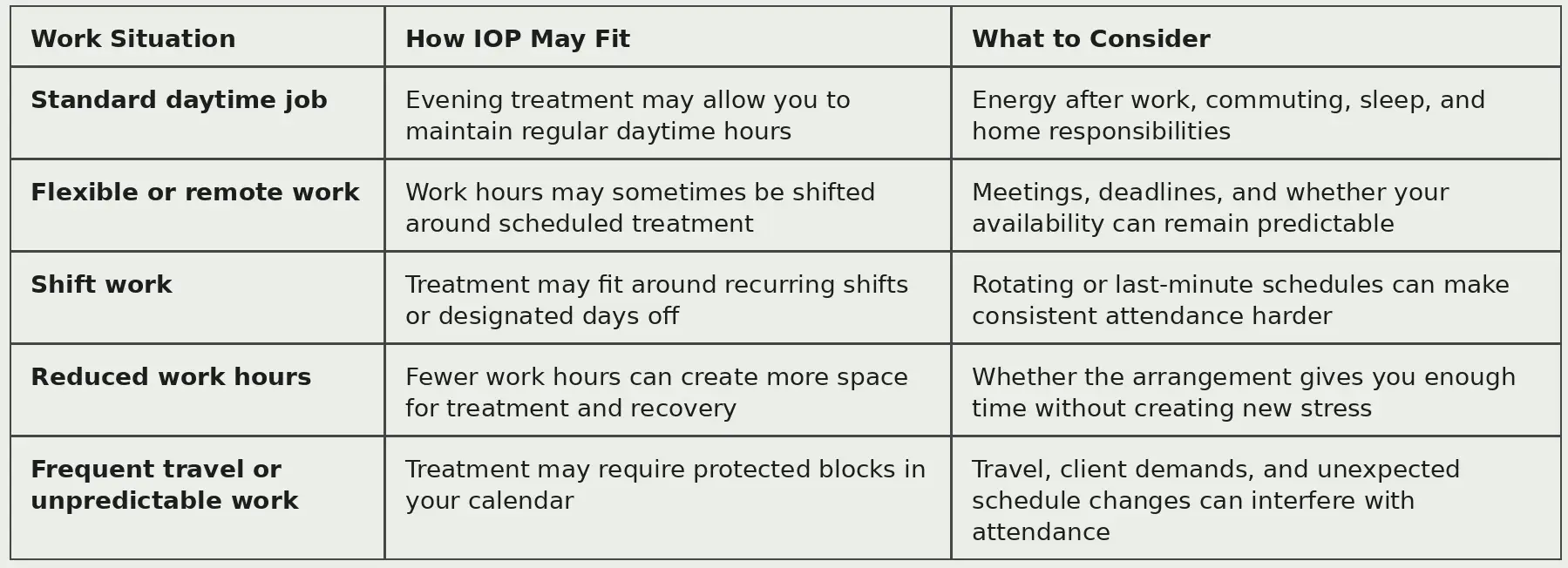
That flexibility still comes with a meaningful treatment commitment. IOP involves substantially more clinical contact than a weekly therapy appointment, so a schedule that technically fits on a calendar may still be difficult if work regularly runs late, involves frequent travel, requires long shifts, or leaves you exhausted before treatment begins.
The type of work you do matters too. Someone with consistent office hours may have an easier time protecting treatment blocks than someone who is on call, rotates shifts, travels frequently, or can’t reliably leave at the end of the workday.
Working while in IOP is most realistic when your job allows you to attend treatment consistently without making the rest of the week unsustainable.
How Can IOP Fit Around Your Work Schedule?
IOP requires a meaningful weekly time commitment. For context, current Medicare coverage criteria define IOP as an organized outpatient service requiring at least nine hours of services per week, although this is a Medicare standard and not a universal schedule for every program or insurance plan.
Can Evening IOP Work With a Full-Time Job?
Evening IOP can be a practical option for people who need structured mental health treatment but have work, school, parenting, or other responsibilities during the day. Saltwood Mental Health offers an in-person evening IOP in Dallas specifically for adults who can’t regularly attend treatment during daytime hours.
Our evening IOP meets during evening hours several days per week, with the exact schedule determined by your clinical needs and treatment plan. Our program is designed for adults, including professionals, parents, students, and caregivers, and many of our clients continue working full time while attending.
Keep in mind, attending in the evening doesn’t lessen the clinical commitment. A full workday followed by several hours of treatment can be demanding, especially if you also have a long commute, early mornings, family responsibilities, or a job that regularly extends beyond scheduled hours. It’s worth considering whether this feels sustainable or not.

How Do You Know If Working While in IOP Is Too Much?
Working during IOP may be too much when the combined demands start interfering with treatment, job performance, or basic daily functioning. One difficult week doesn’t necessarily mean the schedule is unworkable, but recurring problems can signal that something needs to change.
Look for patterns such as:
- Work repeatedly interrupts treatment: Meetings, deadlines, travel, or shifts cause you to miss sessions, arrive late, or leave early
- Symptoms are making work harder to sustain: Anxiety, depression, sleep problems, concentration difficulties, or emotional overwhelm are increasingly affecting your ability to manage your usual responsibilities
- There is little recovery time left: Your days move directly from work to treatment with too little time for sleep, meals, family needs, or basic routines
- Your clinical needs have changed: Your treatment team believes that fewer outside demands or a different treatment schedule would better support your progress
If those patterns continue, you may need to adjust work hours, reduce responsibilities, or consider temporary medical leave rather than trying to maintain the same schedule at all costs.
What Should You Consider Before Working While in IOP?
Can you work while in IOP given your specific schedule? If you’re questioning this, start with the parts of your week that can’t easily move. Look at mandatory work hours, commute time, recurring meetings, travel, and on-call responsibilities alongside treatment sessions rather than evaluating IOP only by the hours spent in the program.
Then consider what happens around those fixed commitments. Finishing work at 5 p.m. and beginning treatment later that evening may appear straightforward until you add in commuting, dinner, family responsibilities, and an early start the next morning. A realistic plan accounts for those transitions instead of assuming every open space on the calendar is usable.
It also helps to think ahead about unpredictable weeks. If quarterly deadlines, business travel, rotating shifts, or certain projects regularly change your availability, discuss that before treatment starts. Knowing where conflicts are likely to occur makes it easier to determine whether the available IOP schedule can support consistent participation rather than repeatedly competing with work.
Talk With Saltwood About IOP and Your Workweek
Your work schedule is one factor in treatment planning, but the level of care still needs to match your clinical needs. Our team evaluates what you’re experiencing, how your symptoms are affecting daily functioning, and how much structure may be appropriate before recommending IOP or another outpatient option.
For adults whose daytime responsibilities make treatment difficult to schedule, our evening IOP offers an alternative built around a typical workweek.
Speak with us today about balancing IOP with your work responsibilities.